Uromastyx Spiny-Tailed Lizard Care: A Complete Ownership Guide
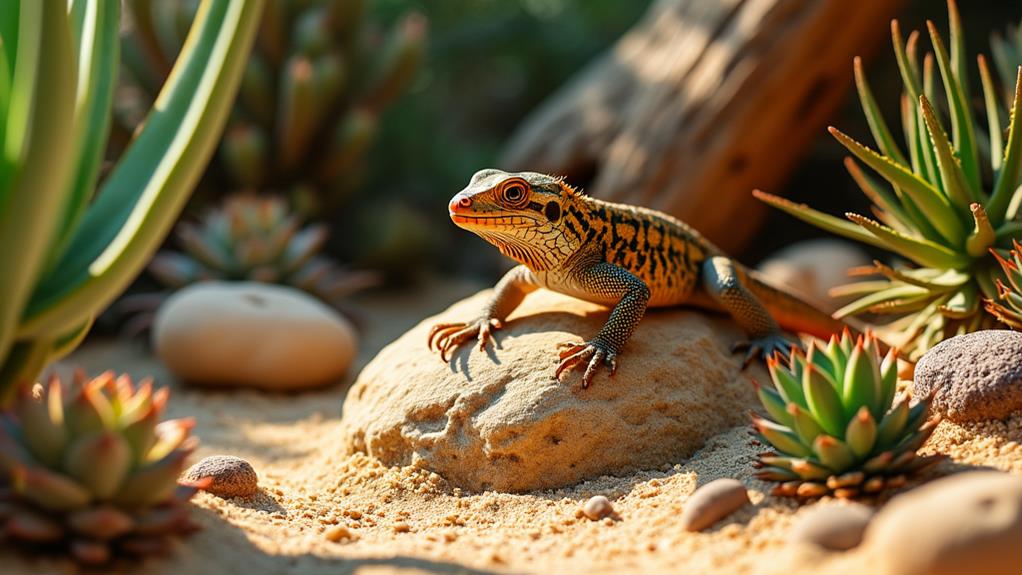
Caring for your Uromastyx Spiny-Tailed Lizard involves recreating their natural desert habitat with a spacious, well-ventilated enclosure that provides a temperature gradient ranging from a 120-130°F basking spot to 80-85°F cooler areas. Use fine sand for burrowing and keep humidity low, between 20-30%. Provide strong UVB lighting and a mainly herbivorous diet of leafy greens, supplemented occasionally with insects for protein. Regular vet check-ups are essential to address health concerns early. Avoid housing them with other reptiles to prevent stress. For a more thorough understanding, there's extensive information available to guide you further.
Key Takeaways
- Provide a large enclosure with a temperature gradient, including a basking area at 120-130°F and a cooler zone around 85°F.
- Use fine sand or sandy soil as substrate, ensuring a minimum depth of 4 inches for burrowing.
- Offer a primarily herbivorous diet, with 70% leafy greens and occasional low-oxalate vegetables.
- Maintain low humidity levels of 20-30% while ensuring strong UVB lighting for proper health and thermoregulation.
- Regular veterinary check-ups are crucial; monitor for lethargy or appetite changes as signs of distress.
Natural Habitat and Origins
Although Uromastyx lizards may seem exotic in your home, they originate from some of the harshest environments on Earth. These resilient reptiles are native to the arid desert regions of North Africa, the Middle East, and parts of Asia. They thrive in rocky terrains where sparse vegetation is the norm. The natural habitat of Uromastyx is an indication of their remarkable adaptability, allowing them to survive where other species might struggle.
The genus Uromastyx encompasses at least 13 species, each with unique adaptations to their environment. Popular species in captivity, such as U. dispar, U. geyri, and U. ornata, showcase varied colorations and sizes. These lizards have developed a special gland near their nostrils that conserves water by excreting mineral salts—a vital adaptation for survival in their dry, demanding habitats.
In terms of size, adult Uromastyx range from 10 to 18 inches, with some, like the Egyptian Uromastyx, growing over 30 inches. Their lifespan can reach 15 to 20 years in captivity, and even up to 30 years with ideal care conditions. Understanding their natural origins helps guarantee you provide the right care and environment.
Enclosure and Environmental Needs
Creating the perfect enclosure for your Uromastyx is vital for their health and happiness. Start by choosing the right size based on your Uromastyx species. Smaller species need a minimum of 4L x 2W x 2H feet, while larger ones require at least 8x4x4 feet. A well-designed enclosure should include fundamental features like a temperature gradient, where the basking area reaches 120-130°F (49-55°C), and a cooler zone around 85°F (29°C). This helps mimic their natural environment and support their care needs.
To guarantee a comfortable habitat, focus on these key elements:
- Substrate: Use fine sand or sandy soil with a minimum depth of 4 inches. This allows your Uromastyx to engage in natural burrowing behaviors and keeps them content.
- Humidity Levels: Maintain low ambient humidity levels of 20-30% to prevent health issues, such as tail rot.
- Hiding Spots and Climbing Structures: Provide plenty of hiding spots and climbing structures to encourage exploration and offer security.
- Ventilation: Confirm the enclosure is well-ventilated, preferably with front-opening access, to promote air circulation and maintain a healthy environment.
These steps will create a thriving habitat for your Uromastyx.
Heating and Lighting Essentials
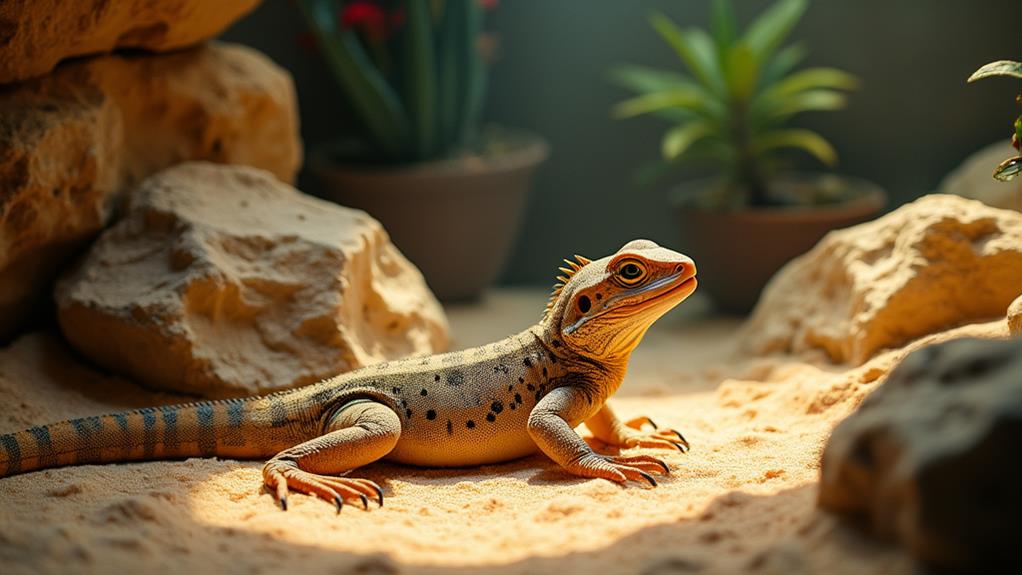
To guarantee your Uromastyx thrives, focus on optimizing the heating and lighting within their enclosure. Proper temperature regulation is critical for their health. Your Uromastyx needs a basking surface temperature between 120-130°F (49-55°C) to guarantee effective thermoregulation and metabolic function. During the day, maintain ambient temperatures from 100°F (38°C) at the warm end to 80°F (27°C) at the cooler end. At night, keep temperatures from dropping below 75°F (24°C).
Strong UVB lighting is crucial for your Uromastyx's health, aiding in calcium absorption and general well-being. Opt for UVB bulbs with an 8-10% output, guaranteeing a UVI of 4.0-6.0. Position these bulbs 10-12 inches from the basking area to prevent burns, and replace them every 4-6 months to maintain effectiveness.
Managing humidity is similarly important. Uromastyx lizards thrive in low humidity levels of 10-30%. You can provide localized higher humidity by using damp sand or soil in dig boxes without increasing the general enclosure humidity. By focusing on these heating and lighting fundamentals, you'll guarantee your Uromastyx receives the care it needs to lead a healthy and active life.
Diet and Nutrition
A balanced diet is vital for your Uromastyx's health and longevity. Providing a proper diet guarantees a healthy body and ideal nutrition. Your Uromastyx's diet should be primarily herbivorous, consisting of:
- Leafy Greens: Make up 70% of their diet with options like collard greens, kale, and dandelion greens. These are excellent sources of important nutrients.
- Vegetables: Comprising 20% of their diet, vegetables introduce variety and supplementary nutrition. Opt for low-oxalate options to prevent interference with calcium absorption.
- Fruits: Limit fruits to 10% of their diet as occasional treats. While they add flavor, they should be given sparingly due to high sugar content.
- Insects: Offer insects like crickets and mealworms sparingly, about five times a month, to supplement protein needs.
Calcium supplementation is vital, particularly for young Uromastyx. Provide calcium carbonate (without D3) 3-4 times a week for juveniles and 2-3 times weekly for adults. Add multivitamins 1-2 times monthly. Avoid high oxalate foods such as spinach and avocados to guarantee proper calcium absorption. Keep fresh water available at all times, but remember, their primary hydration comes from food moisture.
Health and Veterinary Care
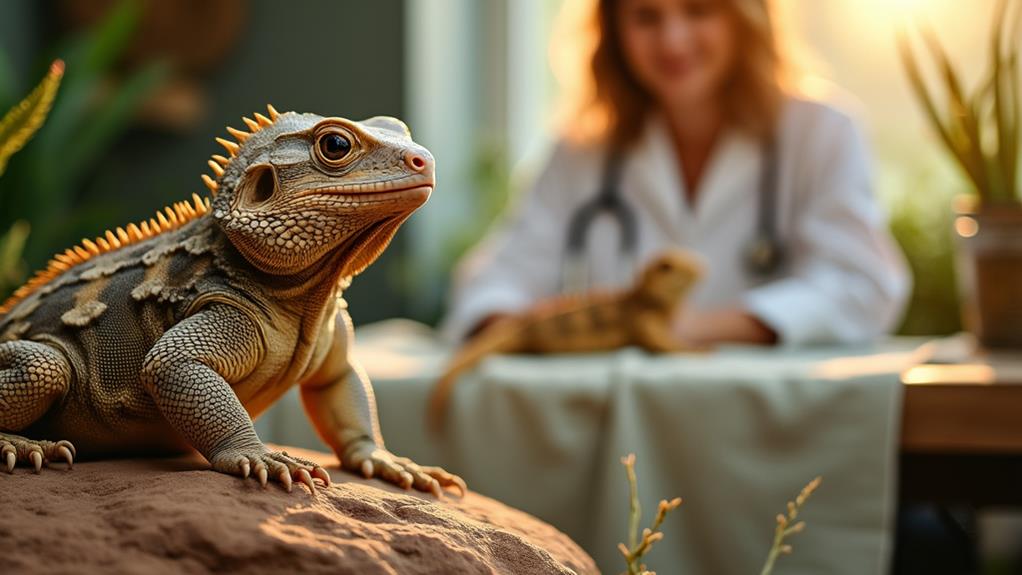
While a balanced diet is key to your Uromastyx's well-being, maintaining its health extends beyond nutrition. Regular veterinary check-ups are fundamental to catch common health problems early, like metabolic bone disease and tail rot. These issues often arise from improper diet and incorrect humidity levels, so confirming the right conditions is crucial. Your Uromastyx might show signs of distress such as lethargy, loss of appetite, or abnormal feces. If you notice any of these symptoms, contact a qualified reptile veterinarian immediately.
Preventing dehydration is another important aspect of your Uromastyx's health care. They primarily get moisture from their diet, so providing adequately hydrated food is necessary. Keeping a dietary log can be incredibly helpful. This record assists veterinarians in diagnosing potential issues and tailoring treatments specific to your pet's needs.
Additionally, avoid cohabitation with other reptiles or species. Territorial disputes can cause stress and injury, negatively impacting your Uromastyx's general health and well-being. By staying vigilant and proactive in these areas, you can help guarantee your Uromastyx leads a healthy, happy life. Regular monitoring and adjustments to their care regime can make all the difference.