Top Fictional Spiders in Pop Culture You Should Know About
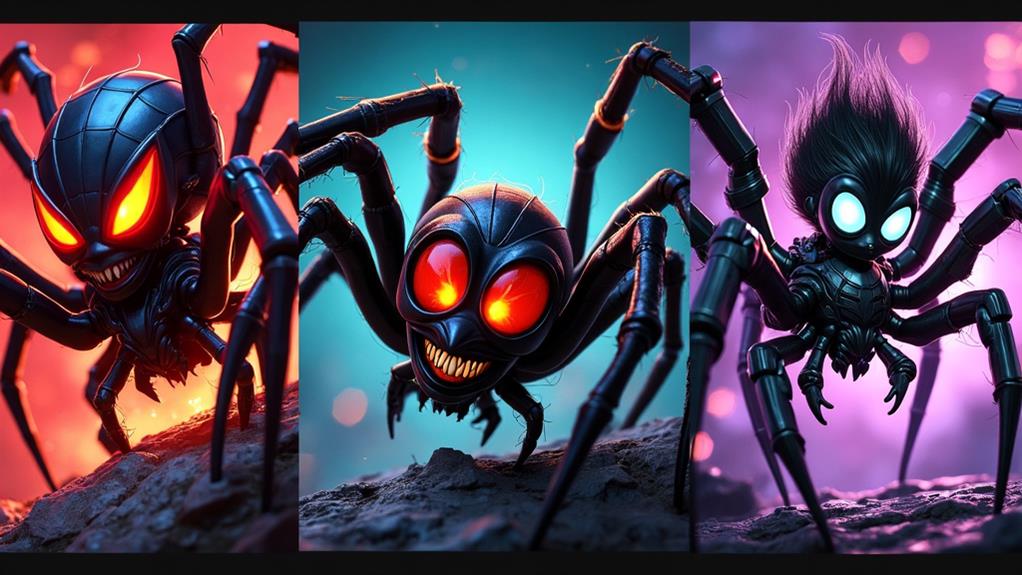
In terms of iconic fictional spiders, there's a web of characters you should know. Start with Spider-Man, known for his web-slinging heroics, and his comical counterpart, Spider-Ham. Harry Potter's Aragog offers loyalty, contrasting with Shelob's sinister presence in Tolkien's lore. Investigate myth with Arachne and gaming's Lolth. Ungoliant in Tolkien's world and Stephen King's IT embody primal fears. Music lovers can't miss The Spiders From Mars, David Bowie's influential band. Anansi charms with trickery, while Charlotte from Charlotte's Web teaches empathy. Even the spider that bit Peter Parker holds legendary status. Each spider reveals a unique thread.
Key Takeaways
- Spider-Man, created by Stan Lee and Steve Ditko, is a cultural icon known for his wall-crawling and web-slinging abilities.
- Charlotte, from Charlotte's Web, showcases compassion and creativity, using her web to communicate important messages.
- Aragog, an Acromantula from Harry Potter, balances ferocity with loyalty to Hagrid, adding complexity to the spider character.
- Shelob, from Tolkien's The Two Towers, is a relentless predator symbolizing unyielding evil and danger.
- Anansi, prominent in African folklore, embodies wisdom and trickery, teaching moral lessons through storytelling.
Spider-Man and Spider-Ham
When you immerse yourself in the world of fictional spiders in pop culture, two standout characters are Spider-Man and Spider-Ham. Spider-Man, created by Stan Lee and Steve Ditko in 1962, initially swung into action in Amazing Fantasy #15. This iconic superhero is known for his wall-crawling abilities, web-slinging skills, and the relatable persona of Peter Parker. You can't ignore his massive cultural impact, having inspired countless adaptations and stories over the decades.
Then there's Spider-Ham, a delightful parody introduced in Marvel's Marvel Tails series. Unlike his serious counterpart, Spider-Ham, or Peter Porker, offers a humorous twist on superhero tales. He's a cartoon pig with scientific genius, bitten by a radioactive spider, granting him spider-like powers. His character shines particularly bright in Spider-Man: Into the Spider-Verse (2018), where he helped introduce the concept of the multiverse to a broader audience.
Spider-Man and Spider-Ham together showcase the versatility of the Spider-Man franchise. They highlight how this character can thrive in both serious narratives and light-hearted parodies, appealing to a diverse audience and reflecting the character's broad cultural reach.
Aragog and Shelob
In the domain of fictional spiders, both Aragog and Shelob stand as formidable figures, each steeped in their own dark mythos. Aragog, introduced in the Harry Potter series, lurks within the Forbidden Forest. As an Acromantula, he speaks and fiercely protects his spider family. His presence exudes fear, yet he shares a complex bond with Hagrid, displaying loyalty amidst his menacing nature. When Harry Potter encounters Aragog in The Chamber of Secrets, he's faced with a creature that balances ferocity with a rare hint of trust for certain humans.
On the other hand, Shelob, a creation from Tolkien's legendary lore, is pure malice. Towering at 15 feet wide, she resides in Cirith Ungol's dark tunnels. Unlike Aragog, Shelob doesn't entertain alliances with humans. Her role in The Two Towers reveals her as a terrifying predator, stalking Frodo and Sam as they traverse her lair. Shelob, daughter of the monstrous Ungoliant, embodies malevolence, capturing and consuming her victims without any remorse. While Aragog occasionally shows loyalty, Shelob remains an unyielding force of evil, symbolizing the themes of fear and danger that both spiders represent in their narratives.
Arachne and Lolth
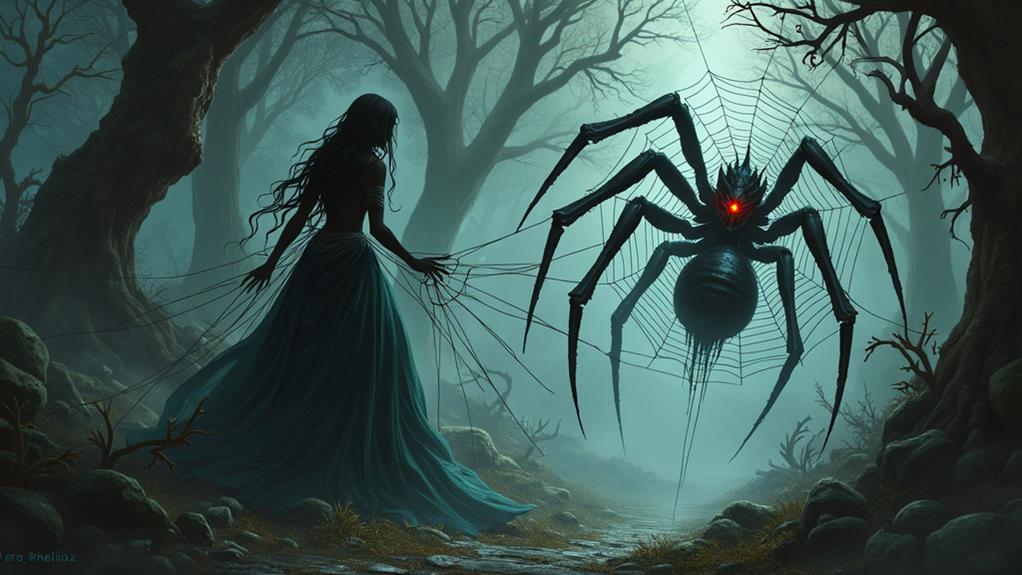
Arachne's tale from Greek mythology serves as a timeless reminder of the dangers of hubris. Known for her extraordinary weaving skills, Arachne dared to challenge Athena, the goddess of wisdom and crafts. Her arrogance led to her transformation into a spider, symbolizing the consequences of defying the divine. Arachne's story is a powerful cautionary tale that continues to inspire modern interpretations and adaptations, reminding you of the fine line between talent and pride.
In contrast, Lolth is a creation for the Dungeons and Dragons universe, where she reigns as the chaotic evil Demon Queen of Spiders. Lolth is the primary goddess for the drow, a dark elf race known for their cunning and ruthless nature. Her influence is marked by manipulation and deception, embodying the darker aspects of spider symbolism. To understand these two iconic figures, consider the following points:
- Transformation: Both Arachne and Lolth symbolize change but in vastly different narratives.
- Symbolism: Spiders are dual symbols of creativity and danger in their stories.
- Legacy: Arachne's myth influences literature, while Lolth impacts fantasy gaming.
- Themes: Arachne focuses on hubris, while Lolth represents chaos and deceit.
These narratives highlight the enduring fascination with spiders in pop culture.
Ungoliant and IT
Darkness takes center stage in the tales of Ungoliant and IT, two notorious arachnid entities that embody the primal fears lurking in the shadows. In J.R.R. Tolkien's legendarium, Ungoliant emerges as a primordial evil, a massive shadowy creature with an insatiable hunger. Her most infamous act involves draining the light from the Two Trees of Valinor, leaving a void of despair. Her alliance with Melkor (Morgoth) showcases her destructive tendencies, but her betrayal marks her as a force of unpredictable darkness. Ungoliant's ability to consume light and life speaks to the self-destructive nature of unchecked evil, contrasting sharply with the beauty she devours.
Meanwhile, Stephen King introduces you to IT, a shape-shifting embodiment of fear residing in Derry, Maine. IT's true form, a giant spider, represents the terror of the unknown. This creature preys upon its victims by manipulating their fears, making it an archetype of horror. When the protagonists confront IT, they encounter not just a spider but the very essence of dread. Both Ungoliant and IT illustrate how darkness can consume and manipulate, serving as chilling reminders of the fearsome power lurking within the unknown.
The Spiders From Mars
Among the most iconic names in rock history, The Spiders From Mars were more than just David Bowie's backing band—they were a vital force in creating the glam rock phase. With Mick Ronson on guitar and Trevor Bolder on bass, they shaped Bowie's sound in the early 1970s, transforming his music and image. Their name, inspired by a 1950s incident where a crowd mistook migrating spiders for UFOs, perfectly encapsulates the blend of science fiction and rock music that defined the time.
In popular culture, The Spiders From Mars weren't just musicians but pioneers of a new aesthetic. Their influence extended beyond music, impacting fashion and challenging societal norms. Here's why they stand out:
- Innovative Sound: They contributed to Bowie's distinctive sound, blending rock with theatrical elements.
- Fashion Icons: Their glam rock style pushed boundaries, influencing the fashion world with bold, androgynous looks.
- Cultural Impact: The band's aesthetic challenged traditional masculinity, leaving a lasting legacy.
- Theatrical Performances: Their live shows were spectacles, setting a new standard for rock concerts.
Without The Spiders From Mars, the glam rock movement—and by extension, popular culture—might've been very different.
Anansi and Miss Muffet's Spider
In the domain of storytelling, spiders like Anansi and Miss Muffet's Spider have spun their webs across cultures, each embodying unique themes that resonate through time. Anansi, a prominent figure in African folklore, captures your imagination with his half-spider, half-man form. Known for his wisdom and cleverness, Anansi often uses trickery to outsmart oppressors, much like Loki from Norse mythology. Through his tales, Anansi teaches the importance of storytelling and imparts moral lessons, showcasing his mischievous yet wise nature.
Meanwhile, Miss Muffet's Spider, from the well-loved nursery rhyme "Little Miss Muffet," plays on childhood fears and the unknown. This spider frightens the young girl during her snack, illustrating how spiders can evoke fear even in a playful context. The character of Miss Muffet's Spider has become a cultural touchstone, symbolizing the unease many feel towards spiders.
Both Anansi and Miss Muffet's Spider highlight the diverse portrayals of spiders in literature. Regardless of embodying wisdom and cunning or evoking fear, these spiders show how cultural narratives shape our perceptions. Their stories continue to inspire and entertain across generations.
The Spider Queen and Kumonga
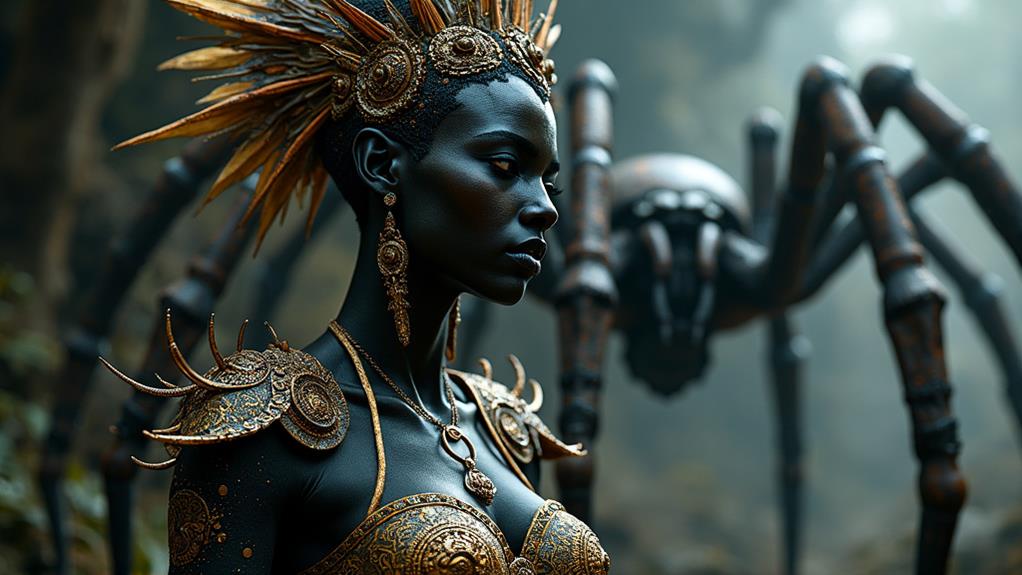
The Spider Queen and Kumonga showcase the enchanting allure and terror that spiders embody in popular culture. The Spider Queen is often portrayed as a cunning antagonist, weaving webs of seduction and control. You'll find her in fantasy domains, such as Dungeons & Dragons, where she exerts power over lesser creatures, embodying chaos and evil. This character's presence in video games and literature further cements her status as a formidable symbol of manipulation and fear.
Kumonga, on the other hand, is a mutant spider-kaiju from Toho's cinematic universe. Its appearance in "Son of Godzilla" left a lasting impression with its ability to shoot poisonous webs and its terrifying design, featuring large, spindly legs. Kumonga's menacing nature appeals to kaiju enthusiasts and horror fans who revel in its depiction of the unknown.
Both the Spider Queen and Kumonga illustrate our cultural fascination with these eight-legged creatures. They serve as powerful symbols of fear and mystery, capturing our imaginations across diverse forms of media. Here are some key points about these iconic characters:
- Manipulative power: The Spider Queen controls and seduces.
- Mutant terror: Kumonga's poisonous webs frighten.
- Chaos and evil: Embodied by the Spider Queen.
- Menacing design: Kumonga's unforgettable appearance.
Charlotte From Charlotte's Web
While the Spider Queen and Kumonga evoke fear and chaos, Charlotte from "Charlotte's Web" offers a heartwarming portrayal of spiders that highlights compassion and creativity. As a fictional spider, Charlotte, a barn spider, forms an unlikely friendship with Wilbur, a pig doomed to be slaughtered. Her intelligence and creativity shine through when she uses her web to spell out messages like "Some Pig," "Terrific," and "Radiant." These words serve not just as a lifeline for Wilbur but also as a demonstration to the power of communication and ingenuity.
Charlotte embodies themes of friendship and sacrifice, ultimately giving her life to guarantee Wilbur's safety. Her actions teach readers about the profound impact of kindness and empathy. The tale of Charlotte's Web, published in 1952, has captivated audiences for decades and remains a staple in children's literature. Its adaptations into films and animated versions have only reinforced its cultural significance and enduring popularity.
The novel's 1953 Newbery Medal win signifies its importance in teaching valuable lessons about empathy and the cycle of life. Charlotte's legacy as a fictional spider continues to inspire kindness and creativity in readers of all generations.
The Spider That Bit Peter Parker
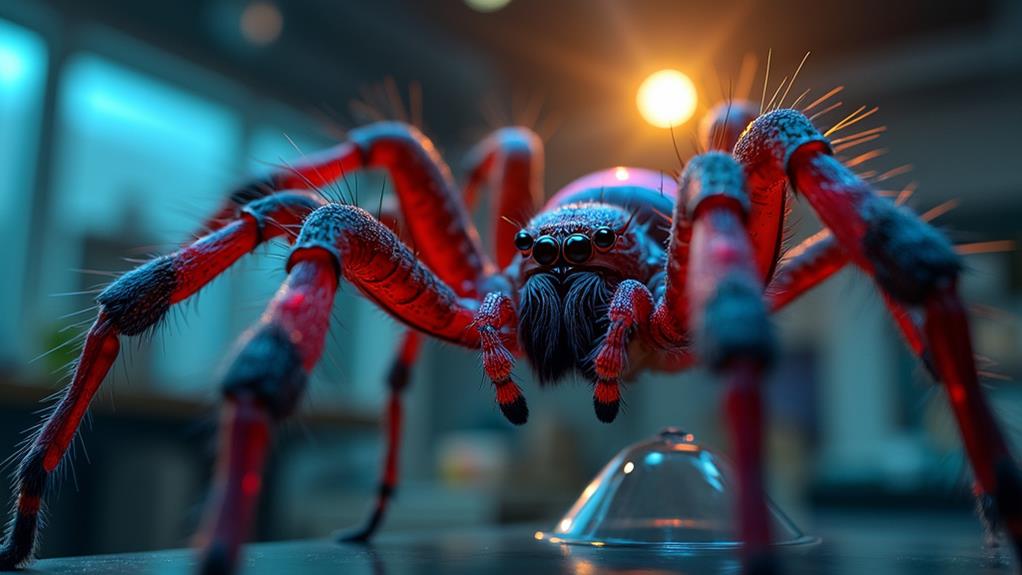
Transforming Peter Parker's ordinary life into an extraordinary one, the bite from a radioactive spider marked the beginning of his expedition as Spider-Man. This significant moment occurred during a radiation test at General Techronics Corporation. You find Peter Parker, a high school student, in the midst of an unexpected life-changing event. The spider's bite wasn't just an accident; it symbolized unforeseen change and the heavy burden of responsibility that followed. This single moment set the stage for countless stories, not just for Spider-Man, but also for others in the Spider-Verse who gained powers from similar bites.
Consider these key facets of the giant spider's impact:
- Origin Point: This event is vital not only for Peter but also for other characters in the Spider-Man universe.
- Adaptations: In diverse media, the spider takes on different roles, sometimes possessing its own backstory.
- Symbolism: The accidental bite highlights themes of change and responsibility inherent in Peter's odyssey.
- Cultural Icon: The spider is a linchpin in pop culture, impacting everything from comic books to movies.
This seemingly small spider played a giant role in shaping one of pop culture's most enduring heroes.